Preparing your Ford for sub-freezing temperatures requires testing your battery, verifying that engine coolant provides freeze protection down to sub-zero temperatures, checking tire tread depth and inflation pressure, installing winter wiper blades, and flushing the washer reservoir with de-icer fluid. Addressing these critical maintenance items before temperatures drop ensures dependable cold-weather starts, reliable stopping power on slick roads, and clear visibility through snow and road spray.
Winter weather in western Indiana places extreme mechanical stress on every major vehicle system. Motor oil thickens in freezing weather, forcing starter motors to work harder while automotive batteries lose a significant percentage of their cranking power. At our service department at 1702 E State Rd 163, Clinton, IN 47842, our factory-trained technicians systematically evaluate these wear points so your vehicle stays reliable through the harshest winter weather.
Rural travel around Clinton frequently involves open agricultural corridors where heavy crosswinds push snowdrifts across exposed rural highways. When drifting snow and sudden temperature drops hit the Wabash Valley, a deferred maintenance item can quickly turn into a roadside emergency. If your vehicle needs seasonal service, our service advisors are available at (765) 820-2278 to review maintenance intervals and inspect your vehicle before freezing weather sets in.
Essential winter preparation involves several mechanical and preventative steps:
- Testing battery health, charging output, and alternator belt tension
- Verifying anti-freeze concentration and radiator hose integrity
- Switching to low-temperature washer fluid rated for sub-zero temperatures
- Examining brake pads, rotors, and calipers for uneven salt-induced corrosion
- Inspecting steering linkages, ball joints, and suspension bushings
Table of Contents
- Ford Intelligent 4WD vs. All-Wheel Drive: How Do They Differ on Winter Roads?
- How Do Ford Slippery and Deep Snow Drive Modes Protect Winter Traction?
- All-Season vs. 3PMSF All-Weather Tires: Which Tread Handles Winter Slush?
- Preventing Cold-Weather Starting Failures: Battery Testing and CCA Requirements
- What Is Included in a Complete Ford Winter Maintenance Inspection and Package?
- What Do Ford Owners Ask About Winter Care?
- Schedule Certified Ford Winter Service at Pilson Ford of Clinton
Ford Intelligent 4WD vs. All-Wheel Drive: How Do They Differ on Winter Roads?
Ford Intelligent All-Wheel Drive (AWD) and Ford Intelligent Four-Wheel Drive (4WD) both work automatically, shifting torque to the axle with the most grip without any driver input, and neither uses low-range gearing. Ford's traditional 4x4 systems, available on trucks like the Ford F-150, work differently: a two-speed transfer case lets the driver lock the front and rear driveshafts together in 4-High or select 4-Low gearing for deep snow. All three optimize traction on freezing pavement, but they handle severe winter terrain using different mechanical approaches.
Intelligent AWD is engineered primarily for car-based crossovers and SUVs such as the Ford Escape. The system monitors vehicle speed, wheel slip, steering wheel angle, and throttle input dozens of times per second. When the front wheels begin slipping on a patch of black ice, an electronically controlled clutch pack within the rear differential engages instantly, sending torque to the rear wheels to stabilize the vehicle. This transitions power seamlessly during daily winter commutes into Terre Haute without requiring the driver to turn any knobs or press buttons.
Ford Intelligent 4WD, found on the Ford Explorer, is a rear-biased automatic system that sends torque to the front axle the moment the rear wheels begin to slip. It has no driver-selectable 4H or 4L settings; instead, Explorer drivers fine-tune winter traction through the Slippery and Deep Snow/Sand drive modes. For deeper snow, the available 4x4 system on the Ford F-150 uses a two-speed transfer case. On equipped models, the driver can select 4A (Automatic Four-Wheel Drive) for variable road conditions, or lock the driveline into 4H (Four-Wheel Drive High) when encountering deep, unplowed snow. Locking the front and rear driveshafts together forces the axles to rotate at identical speeds, preventing loss of forward momentum when cutting through deep drifts.
Routine driveline maintenance is vital for both configurations. Transfer case fluid, front differential lubricant, and rear axle fluid break down over time due to heat cycles and condensation. If your driveline requires fluid replacement or mechanical inspection, our team supplies genuine Ford parts including Motorcraft transfer case fluids, differential gear oils, and OEM seals designed specifically for your model's drivetrain.
How Do Ford Slippery and Deep Snow Drive Modes Protect Winter Traction?
Ford selectable drive modes calibrate throttle response, transmission shift logic, traction control intervention, and anti-lock braking thresholds to optimize tire grip across varying winter road surfaces. Selecting the mode that matches surface conditions allows onboard computers to tailor torque delivery specifically to either compact ice or deep, unplowed snow.
When you rotate the drive mode dial to Slippery mode on an equipped Ford F-150, Explorer, or Escape, the powertrain control module softens throttle sensitivity. Pressing the accelerator pedal results in a gradual, measured delivery of engine power, preventing the sudden torque spikes that cause tires to spin freely on slick surfaces. The transmission shifts earlier into higher gears to keep engine revs low and wheel torque gentle. Simultaneously, the electronic stability control system increases sensitivity, intervening with rapid brake pulses at individual slipping wheels to prevent vehicle rotation before a skid develops.
The Deep Snow/Sand mode uses an opposite calibration strategy:
- Allows controlled wheel spin so aggressive tire treads can clear packed slush and dig down to solid ground
- Holds lower transmission gears longer to maintain forward engine momentum
- Delays stability control intervention so engine power is not abruptly cut when momentum is required
- Biases power delivery evenly across all four wheels to push through heavy snow banks
Neither drive mode replaces the physical limits of tire adhesion, but both configurations optimize how the powertrain transfers power to the road surface during winter storms.
All-Season vs. 3PMSF All-Weather Tires: Which Tread Handles Winter Slush?
All-Weather tires carrying the Three-Peak Mountain Snowflake (3PMSF) symbol deliver significantly better stopping power and acceleration in freezing temperatures than standard All-Season tires because their rubber compound remains pliable below 45 degrees Fahrenheit. Standard All-Season tires feature tread rubber designed for high summer temperatures, causing the tread compound to stiffen into hard plastic as temperatures plunge, which increases braking distances on snow and ice.
The 3PMSF rating on the tire sidewall indicates that the tire meets standardized industry testing criteria for severe snow traction. All-Weather tires bridge the gap between traditional All-Season designs and dedicated winter tires. They incorporate specialized silica-infused compounds that retain elasticity in deep winter cold while remaining durable enough to drive safely through hot summer months. Deep siping throughout the tread blocks creates biting edges that grip packed snow and evacuate slush, reducing the likelihood of slushplaning on highway slush ruts.
Maintaining proper tire pressure during winter is equally critical to tread performance. For every 10-degree drop in ambient temperature, tire pressure decreases by approximately one to two pounds per square inch (PSI). Underinflated tires wear rapidly along the outer shoulders and compromise directional stability. You can schedule professional tire inspection and rotation to confirm your tread depth, check wear patterns, and install tires rated for severe winter conditions.
Preventing Cold-Weather Starting Failures: Battery Testing and CCA Requirements
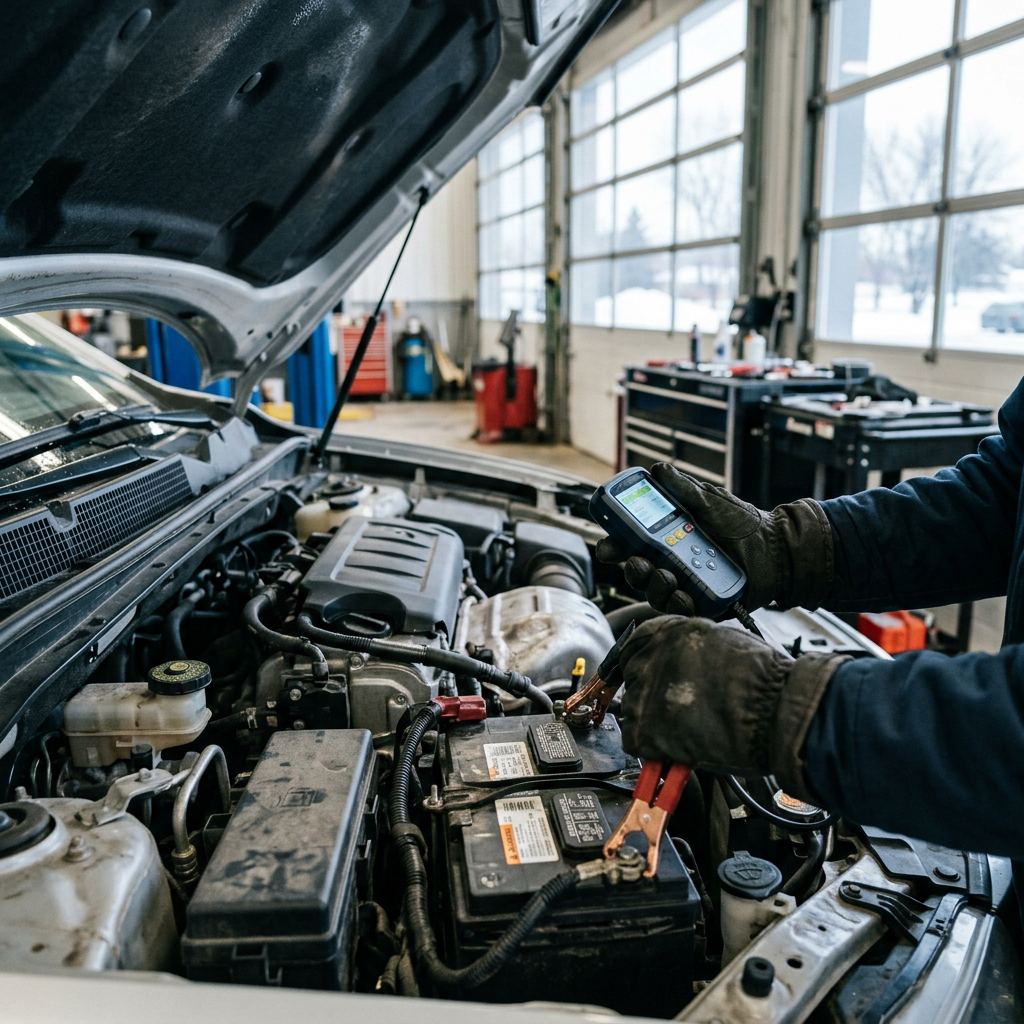
Cold-weather starting failures occur because freezing temperatures can cut a lead-acid battery's starting power by about 60 percent at zero degrees Fahrenheit (and about 35 percent at 32 degrees), while engine oil thickens and requires significantly higher electrical current to crank the engine. Testing battery health before the first hard freeze identifies failing cells before they leave you stranded in your driveway.
You can perform a basic state-of-charge test at home using a standard digital multimeter set to direct current (DC) volts. Connect the red positive lead to the positive terminal and the black negative lead to the negative terminal with the engine switched off:
- A fully charged battery reads 12.6 volts or higher, indicating healthy cell voltage.
- A reading between 12.2 volts and 12.4 volts indicates an undercharged state (approximately 50 to 75 percent capacity).
- Any reading below 12.0 volts indicates an unserviceable or deeply discharged battery that will struggle to crank an engine on sub-freezing mornings.
A multimeter measures static voltage, but it does not measure Cold Cranking Amps (CCA) under an active load. Ford trucks equipped with large-displacement engines, such as the 3.5L EcoBoost in the Ford F-150, require high-output batteries typically rated between 650 CCA and 850 CCA to overcome high compression and thick cold oil. Crossovers like the 1.5L Ford Escape typically require between 500 CCA and 650 CCA.
Corrosion around the battery posts adds electrical resistance, choking off the flow of current to the starter motor. To verify your vehicle's starting reliability, schedule an appointment to have your battery and charging system tested using calibrated conductance testers that evaluate internal cell health and cold cranking output.
What Is Included in a Complete Ford Winter Maintenance Inspection and Package?
A comprehensive Ford winter service package inspects all critical cold-weather wear items, including a digital battery load test, coolant freeze-point analysis, tire inspection, brake examination, and an oil and filter change using the Ford-specified motor oil for your engine. Having these systems checked together ensures that every component working against the cold operates within factory tolerances.
During an inspection, certified technicians utilize refractometers to test the freeze-point concentration of your engine coolant, ensuring protection down to -34 degrees Fahrenheit to prevent engine block cracking. The technicians inspect the heating, ventilation, and air conditioning (HVAC) system to verify that the defroster and heater core operate efficiently. They also inspect the underside of the vehicle, checking steering linkages, exhaust heat shields, and suspension components that suffer from winter road-salt accumulation.
Regularly rinsing the underbody and wheel wells during the winter months prevents de-icing chemicals from corroding electrical harnesses and brake lines. You can schedule your winter maintenance appointment online to ensure your Ford is prepared for the cold months ahead.
What Do Ford Owners Ask About Winter Care?
Q: Does Ford Slippery mode automatically lock the rear differential?
Ford Slippery mode does not automatically lock the rear mechanical differential. Instead, the mode relies on electronic traction control to gently pulse the brakes on spinning wheels while smoothing out throttle response and adjusting transmission shift points. On trucks equipped with an electronic locking rear differential, the driver must manually engage the locking switch if maximum axle lock is needed in deep snow.
Q: How do freezing temperatures affect Ford hybrid and electric vehicle range?
Cold weather can reduce electric driving range by roughly 40% at 20 degrees Fahrenheit with the cabin heater running, according to AAA testing, because cold slows down lithium-ion battery chemistry and operating the cabin heater draws electrical energy directly from the high-voltage pack. Utilizing scheduled cabin preconditioning while the vehicle remains plugged into a home charger warms both the battery pack and interior using grid power, preserving battery range for driving.
Q: Can road salt affect my Ford vehicle's braking performance?
Road salt and liquid magnesium chloride accelerate surface corrosion on brake rotors and cause brake caliper slide pins to seize if not periodically cleared. Seized caliper pins cause brake pads to drag or wear unevenly, leading to reduced stopping efficiency on slick surfaces. Drivers can schedule an inspection to check brake pads and caliper hardware to ensure stopping safety during winter driving.
Q: What should I do if my Ford breaks down in severe winter weather?
If severe winter weather leaves your vehicle disabled, stay inside the cabin to remain sheltered from wind and freezing temperatures while awaiting assistance. Vehicles covered under factory warranty include roadside coverage, and you can contact Ford Roadside Assistance: 1-800-241-3673 for fuel delivery, jump starts, or towing to an authorized Ford dealership service facility.
Q: Why does my tire pressure warning light illuminate on cold mornings?
Cold ambient air contracts, lowering the internal air pressure of your tires by approximately one to two PSI for every 10-degree drop in outside temperature. When overnight temperatures plunge, the pressure drops below the trigger threshold of the Tire Pressure Monitoring System (TPMS). Inflating tires to the recommended cold tire pressure specified on the driver's door jamb placard restores proper pressure and turns off the warning light.
Schedule Certified Ford Winter Service at Pilson Ford of Clinton
Winter weather demands dependable performance from your vehicle's battery, brakes, tires, and heating systems. Our factory-trained technicians at Pilson Ford of Clinton possess the diagnostic equipment, specialized tools, and genuine Motorcraft parts required to keep your Ford car, SUV, or truck running at peak capability throughout the season. Visit our service center at 1702 E State Rd 163, Clinton, IN 47842 or call our service department at (765) 820-2278 to book your winter maintenance inspection today.
© 2026 Pilson Ford of Clinton. All rights reserved.